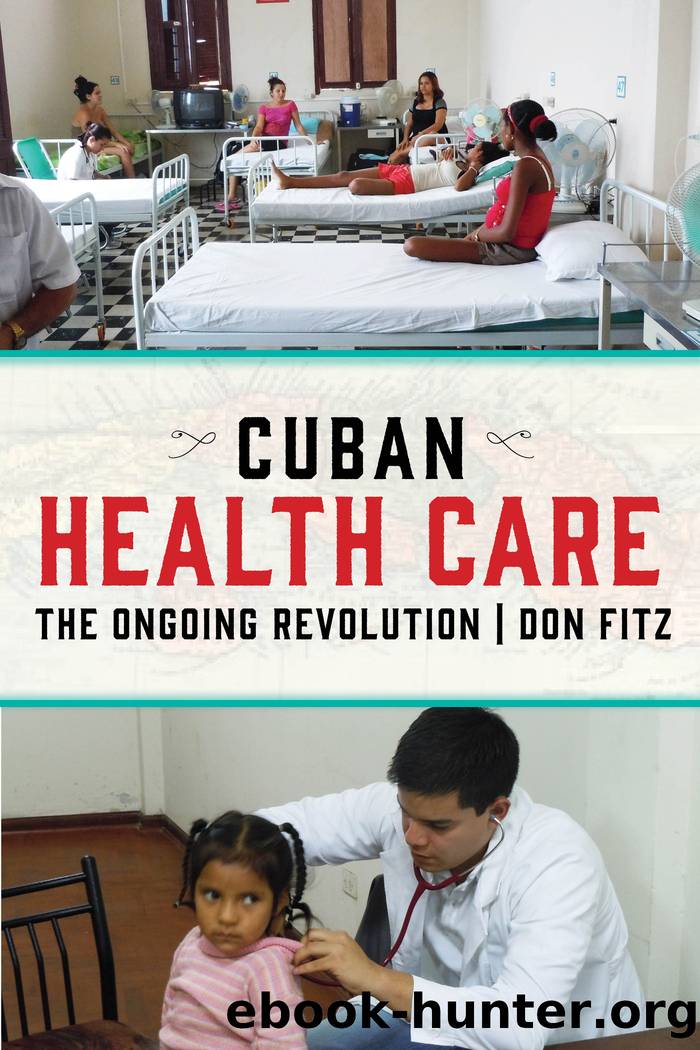
Cuban Health Care: The Ongoing Revolution by Don Fitz
Author:Don Fitz
Language: eng
Format: epub
Publisher: NYU Press
Published: 2020-11-15T00:00:00+00:00
STUDENT HEALTH BRIGADES
After the third class graduation at ELAM, the Student Congress proposed creating the opportunity to work on specific projects during summer vacation months. The faculty approved, and students began designing projects designated as Student Health Brigades (Brigadas Estudiantiles por la Salud, or BES) that would take them to clinics in impoverished urban and rural communities of South and Central America as well as throughout the rest of the world, including the United States.
The Yaa Asantewaa Brigade (YAB), whose key organizers include Omavi Bailey and Ketia Brown, illustrates how BES projects function.12 YAB is the group that will carry out the âAfrican Medical CorpâGhana Project.â It was designed by the Organization of African Doctors (OAD), a group of African and African-American medical students. Founded in 2009 on the ELAM campus, OAD adopted the mission of developing âprograms, projects and institutions with the objective of producing an organized, politically conscious and socially responsible medical body able to meet the needs of African people suffering from health-related issues throughout the African world. OAD is composed of 160 students, interns, and residents trained in Cuba currently representing over thirty-five countries.â13
Currently, the âbrain drainâ of African doctors getting jobs in Europe or the United States leaves Ghana with just one doctor for every 45,000 residents. Similarly, there are more Ethiopian doctors in Chicago than in Ethiopia.14 OAD aims to confront this problem head on by strengthening the directive at ELAM that African (and all other) medical students return to serve impoverished communities in their homelands.
The 2010 phase of the Ghana Proposal began with ELAM students traveling to Ghana to meet with Cuban-trained doctors already there. In the communities they visit, ELAM students intend to
1. Perform an assessment of the sources of health care that residents already have;
2. Establish groups of medical students who do physical exams and learn Ghanaian traditional medicine; and
3. Hold community meetings to strengthen ties with Ghanaian residents by finding out what health care they want.
Depending on the results, YAB hopes to create an internship so that sixth-year ELAM students can complete their medical training in Ghana. ELAM students in Ghana will have experiences that differ vastly from those of medical students in the United States. Unlike the overdeveloped countries, where the major causes of death are âlife-style diseasesâ such as strokes and heart attacks, the principal causes of death in Ghana are preventable infectious diseases.15 It is no accident that YAB aims to look at Ghanaian access to services, beliefs about health care, and desires for change, rather than jumping in to provide predetermined services that may not fit the life of an African village. Training at ELAM places heavy emphasis on the evolving social context of medicine, a model that applies particularly well to tight-knit communities.
Even though traditional and natural medicine are often ridiculed in the West, they remain the primary mode of prevention and treatment for 85 percent of African people.16 Thus, the Cuban model of Comprehensive General Medicine (Medicina General Integral, or MGI), which approaches health
Download
This site does not store any files on its server. We only index and link to content provided by other sites. Please contact the content providers to delete copyright contents if any and email us, we'll remove relevant links or contents immediately.
| Africa | Americas |
| Arctic & Antarctica | Asia |
| Australia & Oceania | Europe |
| Middle East | Russia |
| United States | World |
| Ancient Civilizations | Military |
| Historical Study & Educational Resources |
The Dawn of Everything by David Graeber & David Wengrow(1707)
The Bomber Mafia by Malcolm Gladwell(1625)
Facing the Mountain by Daniel James Brown(1553)
Submerged Prehistory by Benjamin Jonathan; & Clive Bonsall & Catriona Pickard & Anders Fischer(1455)
Wandering in Strange Lands by Morgan Jerkins(1430)
Tip Top by Bill James(1416)
Driving While Brown: Sheriff Joe Arpaio Versus the Latino Resistance by Terry Greene Sterling & Jude Joffe-Block(1376)
Red Roulette : An Insider's Story of Wealth, Power, Corruption, and Vengeance in Today's China (9781982156176) by Shum Desmond(1359)
Evil Geniuses: The Unmaking of America: A Recent History by Kurt Andersen(1354)
The Way of Fire and Ice: The Living Tradition of Norse Paganism by Ryan Smith(1336)
American Kompromat by Craig Unger(1315)
F*cking History by The Captain(1304)
It Was All a Lie by Stuart Stevens;(1300)
American Dreams by Unknown(1286)
Treasure Islands: Tax Havens and the Men who Stole the World by Nicholas Shaxson(1274)
Evil Geniuses by Kurt Andersen(1257)
White House Inc. by Dan Alexander(1212)
The First Conspiracy by Brad Meltzer & Josh Mensch(1174)
The Fifteen Biggest Lies about the Economy: And Everything Else the Right Doesn't Want You to Know about Taxes, Jobs, and Corporate America by Joshua Holland(1126)
